 CA
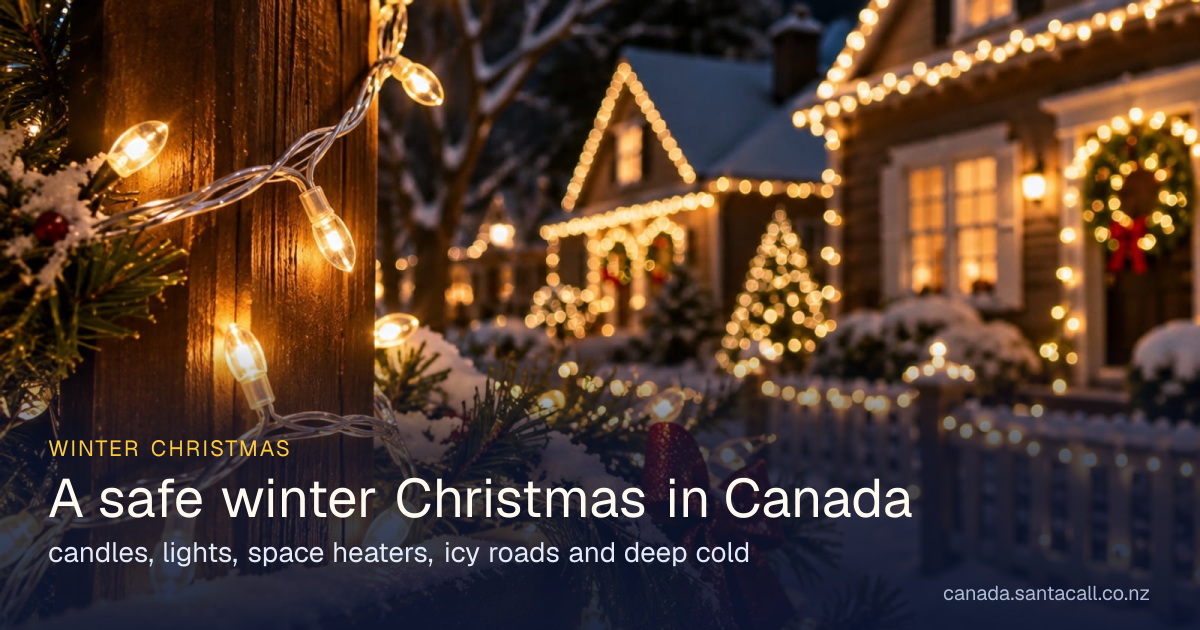
December in Canada means candles in the window, lights on the tree, a space heater in the basement and long drives to family in the dark. None of it is dangerous with a little care. Here is a checklist drawn from what Canadian fire services and road safety agencies tell families every year.
Candles
Keep flames well away from decorations, curtains, pets and children. Use a sturdy holder that will not tip, and blow candles out whenever you leave the room or go to bed. Battery-powered candles look almost as good and are the safer choice anywhere a child or a cat can reach.
Christmas lights
- Choose LED lights. They run cool and use less power.
- Check every string before it goes up and throw out any with cracked wires or broken sockets.
- Use strings marked for outdoor use outside, and fasten them with plastic clips rather than nails or staples.
- Look for a certification mark from a recognized body, such as CSA or cUL, on the box.
- Turn lights off at bedtime and when you go out. A plug-in timer makes it automatic.
The tree
A dry tree burns fast. Water a real tree every day and keep it away from furnace vents, fireplaces and heaters. Our guide to buying a real Christmas tree and keeping it fresh has the full routine.
Space heaters and fireplaces
Ottawa Fire Services, like most fire departments, advises keeping at least 1 metre (3 feet) between a space heater and anything that can burn, such as paper, bedding, curtains and wrapping. Plug heaters straight into the wall, not into a power bar, and switch them off when you leave the room. Use a screen in front of the fireplace, and never burn wrapping paper in it.
Alarms
Make sure there is a working smoke alarm on every storey of your home, test it monthly and change the batteries every year. If you have a fuel-burning furnace, fireplace, stove or an attached garage, put in a carbon monoxide alarm too (in some provinces it is the law). Visiting family? Show them where the exits are and what the alarms sound like.
In the kitchen
Most home fires start in the kitchen. Stay with the stove while anything is cooking, keep tea towels and oven mitts away from burners, and turn pot handles inward so small hands cannot grab them.
Icy roads
Holiday driving often means long trips in the dark on snowy highways. Check the forecast and your province's road conditions before you leave, and be willing to go a day later. In Quebec, winter tires are required by law from December 1 to March 15, and other provinces have their own rules for some highways, so check before a long trip. Keep a winter kit in the car: a blanket, a shovel, a scraper, booster cables, a flashlight, water and snacks. Never warm the car up in a closed garage.
Deep cold
Check the wind chill as well as the temperature. Environment and Climate Change Canada says that at a wind chill of minus 28 to minus 39, exposed skin can freeze in 10 to 30 minutes, and faster than that in strong wind. Dress kids in layers, with a toque, mitts and a neck warmer, and bring them in for a warm-up before they say they are cold. Children often do not notice until their fingers hurt.
Safe and cozy
Once the checklist is done, the best part of a Canadian winter evening is staying in. A phone call from Santa on a cold December night, with everyone in pyjamas by the tree, needs no driving at all.
Common questions
How far should a space heater be from things that can burn?
Fire services such as Ottawa Fire Services advise at least 1 metre (3 feet) between a space heater and anything that can burn.
Are winter tires mandatory in Quebec?
Yes. In Quebec, winter tires are required from December 1 to March 15 inclusive.
How fast can frostbite happen in Canadian cold?
Environment and Climate Change Canada says exposed skin can freeze in 10 to 30 minutes at a wind chill of minus 28 to minus 39, and faster in strong wind.
Which Christmas lights are safest?
LED lights run cool and use less power. Use outdoor-rated strings outside and throw out any with damaged wires.